Pharmacology I · Exam 1 · Lecture 3
Autonomic Receptor Chart
Alpha-1, alpha-2, beta-1, beta-2, muscarinic and nicotinic — where each one sits, what it does, and every drug in the lecture that turns it on or off.
Six receptors, each read the way he said to think: where it sits → what it does → which drugs turn it on and off, with every drug filed under the class the lecture puts it in. Slides cited on every card.
The deck has no table like this. It teaches the receptors on
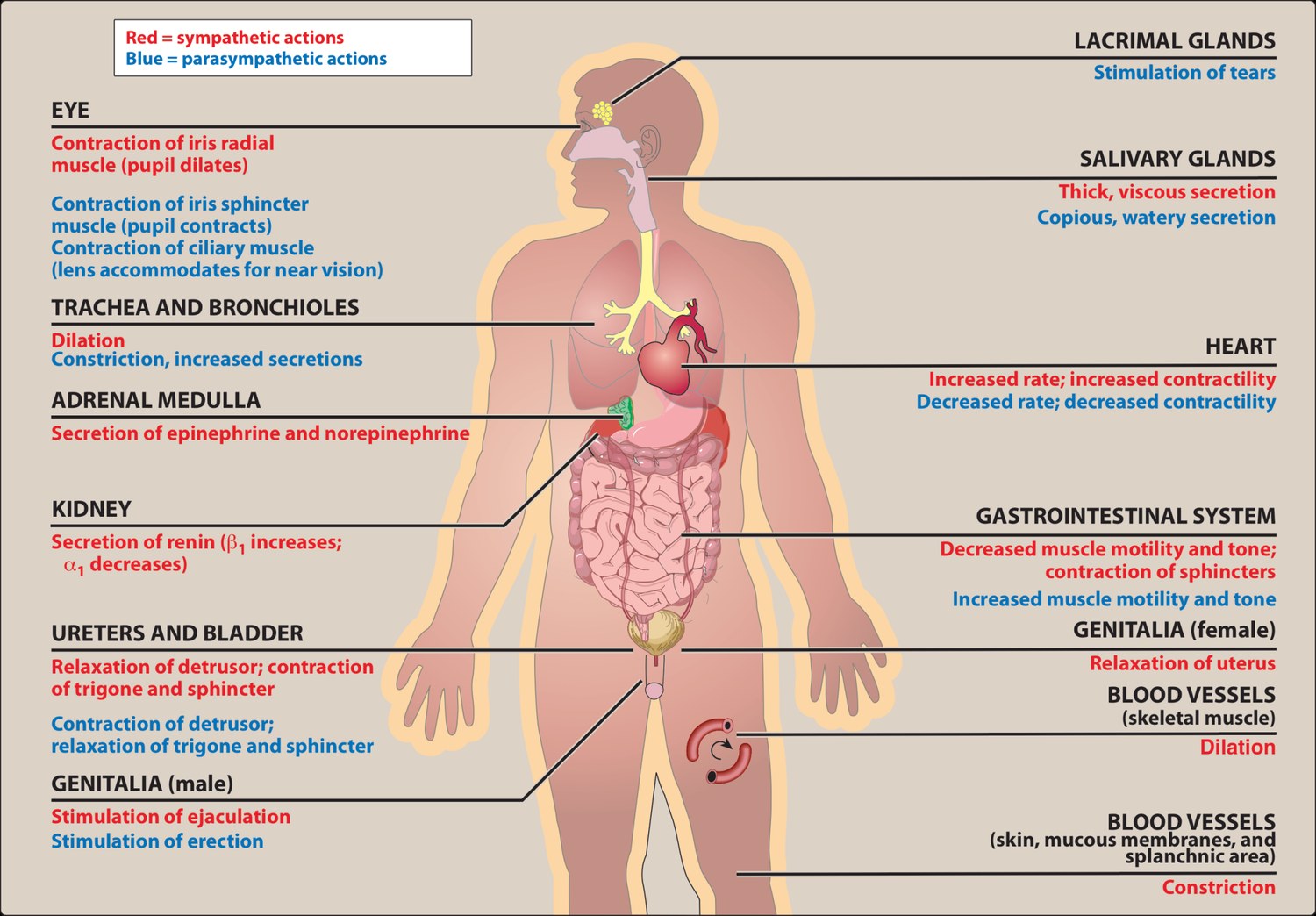
slides 22 to 24 and 76 to 78, the organ actions as a figure on slide 11, and then the drugs
one at a time across nearly a hundred slides. Everything here is from those slides; putting
it in one place is what the page is for.
Two memory hooks are NOT from the lecture and are labeled where
they appear: one heart, two lungs for beta-1 against beta-2. They are standard
mnemonics, included because the point of this page is to be memorable, and flagged so they
are not mistaken for something the deck said.
The whole thing in six lines memorize this
Alpha-1
Squeeze
constricts vessels · raises pressure
Alpha-2
Brake
presynaptic — turns the system DOWN
Beta-1
Heart
rate & force up · renin up
Beta-2
Lungs
opens airways · dilates muscle beds
Muscarinic
Rest and digest
secretions, contractions, slowing
Nicotinic
Ganglia and muscle
ganglia, adrenal medulla, muscle
The two that catch people. Alpha-1 and alpha-2 pull in opposite directions, and it is not the number that decides — it is where the receptor sits. Alpha-1 is on the target organ, so stimulating it squeezes. Alpha-2 is on the nerve ending before the target, so stimulating it turns the whole outflow down. That is why phenylephrine raises blood pressure and clonidine lowers it, though both are alpha agonists.
And beta-2 is why “non-selective” matters. Propranolol, timolol and nadolol block beta-2 as well as beta-1 — which closes airways.
And beta-2 is why “non-selective” matters. Propranolol, timolol and nadolol block beta-2 as well as beta-1 — which closes airways.
Alpha-1 Squeeze
Where
On the postsynaptic membrane of the effector organ — the receiving end.
What it does
- Vasoconstriction, so blood pressure rises — systolic and diastolic
- Pupil dilates by contracting the iris radial muscle
- Contracts the bladder trigone and sphincter
- Decreases renin secretion — the opposite of beta-1
Hook
Alpha-1 squeezes. Vessels, sphincters and the pupil all tighten.
Turned ON by
Direct-acting — catecholaminesnorepinephrine · epinephrine (higher doses) · dopamine (very high doses)
Direct-acting — syntheticphenylephrine · oxymetazoline
Indirect-actingamphetamine · cocaine
Mixed-actionephedrine · pseudoephedrine
Turned OFF by
Selective alpha-1 blockers — the “-osins”prazosin · terazosin · doxazosin · tamsulosin · alfuzosin
Non-selective alpha blockersphentolamine (competitive) · phenoxybenzamine (irreversible)
Combined alpha and beta blockerslabetalol · carvedilol
Slides 76, 82, 96, 99, 103, 107, 111
Alpha-2 Brake
Where
On presynaptic nerve endings — the sending end, not the target organ.
What it does
- Reduces sympathetic outflow from the central vasomotor centers
- Vasodilation and a fall in blood pressure follow
- This is why an alpha-2 agonist lowers pressure while an alpha-1 agonist raises it — the location, not the letter, decides
Hook
Alpha-2 is the brake on the system itself. Because it sits presynaptically, stimulating it turns the sympathetic outflow DOWN.
Turned ON by
Direct-acting — syntheticclonidine · oxymetazoline
Turned OFF by
Non-selective alpha blockersphentolamine · phenoxybenzamine
Slides 76, 82, 97, 107, 108
Beta-1 Heart
Where
Mainly the heart, and the kidney.
What it does
- Increases heart rate — positive chronotrope
- Increases contractility — positive inotrope
- Increases renin secretion from the kidney
Hook
You have ONE heart — beta-1. Memory hook, not from the slides.
Turned ON by
Direct-acting — catecholaminesisoproterenol · epinephrine · norepinephrine · dopamine
Direct-acting — syntheticdobutamine (beta-1 selective)
Indirect-actingamphetamine
Turned OFF by
Selective beta-1 antagonistsmetoprolol · atenolol · bisoprolol · betaxolol · acebutolol
Non-selective beta antagonistspropranolol · timolol · nadolol
With partial agonist activityacebutolol · pindolol
Combined alpha and beta blockerslabetalol · carvedilol
Slides 11, 79, 82, 94, 113, 114, 120, 121, 122
Beta-2 Lungs
Where
Bronchial smooth muscle, and the vessels of skeletal muscle.
What it does
- Bronchodilation
- Vasodilation in skeletal muscle beds
- Relaxes the uterus
- Contributes to hyperglycemia with epinephrine
Hook
You have TWO lungs — beta-2. Memory hook, not from the slides. It is also why a NON-selective beta blocker is a problem in asthma: blocking beta-2 closes the airway.
Turned ON by
Direct-acting — catecholaminesisoproterenol · epinephrine
Direct-acting — syntheticalbuterol (beta-2 selective)
Mixed-actionephedrine · pseudoephedrine
Turned OFF by
Non-selective beta antagonistspropranolol · timolol · nadolol — this is the asthma problem
Combined alpha and beta blockerslabetalol · carvedilol
Slides 79, 84, 98, 103, 113, 119, 122
Muscarinic Rest and digest
Where
M1 neurons and gastric parietal cells · M2 neurons, cardiac cells and smooth muscle · M3 neurons, bladder, exocrine glands and smooth muscle. Only these three are functionally characterized.
What it does
- Defecation · Urination · Miosis
- Bradycardia · Bronchorrhea · Bronchospasm
- Emesis · Lacrimation · Salivation
- The lens also accommodates for near vision
Hook
DUMBBELS — and every one of them is a secretion, a contraction or a slowing. Blocking them gives you the exact opposite, which is the anticholinergic toxidrome.
Turned ON by
Direct-acting — choline estersacetylcholine · carbachol · bethanechol
Direct-acting — natural alkaloidspilocarpine
Indirect — reversible cholinesterase inhibitorsedrophonium · physostigmine · neostigmine · pyridostigmine · donepezil, rivastigmine, galantamine
Indirect — irreversiblethe organophosphates
Turned OFF by
Antimuscarinics — naturalatropine · scopolamine
Antimuscarinics — syntheticipratropium · tiotropium · glycopyrrolate
Antimuscarinics — bladder agentsoxybutynin · tolterodine · solifenacin · darifenacin · fesoterodine · trospium
Slides 11, 23, 26, 28, 30, 34, 40, 42, 46, 47, 55, 56
Nicotinic Ganglia and muscle
Where
Autonomic ganglia, the adrenal medulla, the neuromuscular junction and the central nervous system.
What it does
- Mydriasis · Tachycardia
- Weakness, meaning paralysis
- Hypertension · Fasciculations
- Structurally a ligand-gated ion channel: two acetylcholine molecules bind and sodium flows in
Hook
M-T-W-H-F, the days of the week — and note it is the mirror image of the muscarinic list on the pupil and the heart.
Turned ON by
Direct-acting — choline esterscarbachol (muscarinic and nicotinic) · acetylcholine
Depolarizing neuromuscular blockersuccinylcholine — agonist first, paralysis second
Ganglionic stimulantnicotine — stimulates low, blocks high
Turned OFF by
Non-depolarizing neuromuscular blockersrocuronium · vecuronium · pancuronium · cisatracurium · tubocurarine
Ganglionic blockersall non-depolarizing competitive antagonists except nicotine
Slides 24, 29, 58, 59, 61, 62, 66
The same thing organ by organ slide 11
Sympathetic actions in red, parasympathetic in blue. Read it against the cards above: everything red is alpha or beta, everything blue is muscarinic.